
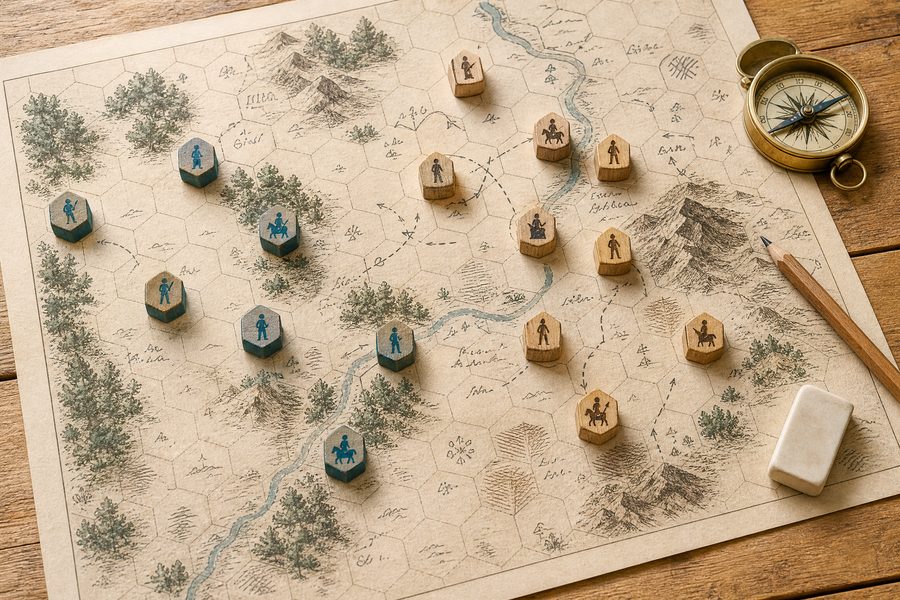
The moment this game explained itself to me came in the fourth mission, when I lost six units in two turns by doing something that would have been correct in every other game of its kind. I had a flanking position, a clear line of advance, and an enemy formation that looked committed. I advanced. What I had not accounted for is that in this game an enemy formation is never committed, because the opposing commander is permitted to change its mind at a cost — and the cost is one that a competent opponent is usually willing to pay.
That single rule reorganises the entire genre. Tactics games are built on the assumption that reading intent is a skill: you observe a formation, infer a plan, and position against it. Here, intent is a resource rather than a fact, and a plan you have correctly identified can be abandoned specifically because you identified it.
Hesitation as a mechanic
Your own version of this ability is the hold order, and it is the most interesting verb I have used in a strategy game in years. A unit on hold does not move, does not attack, and does not generate any of the usual resources. What it does is remain unresolved: the opposing side cannot see its facing, cannot predict its threat range, and — critically — cannot bait it. A held unit is information denied.
The first ten hours I barely used it, because holding feels like waste. Every instinct trained by twenty years of this genre says that a turn without action is a turn lost. Around hour fourteen I started holding one unit per turn as an experiment, and my win rate on the harder difficulty improved immediately and substantially. By hour thirty I was holding two or three, and playing what an observer would probably describe as an extremely boring game of extremely high tension.
The genre has spent decades teaching players that tempo is everything. This game quietly argues that tempo is what you give away when you cannot tolerate ambiguity.
What the campaign does with the idea
- Missions with no objective marker. Roughly a third of the campaign gives you a region and a condition rather than a target, so the first two turns are genuinely about deciding what the mission is.
- Escalating commanders. Each of the five opposing commanders uses the intent-change rule differently, and one of them uses it almost never, which is far more disorienting than it sounds.
- Attrition that persists. Units carry damage between missions with no free repair, so a won battle can be a strategic loss and the game never softens that.
- A supply layer that is legible. Three resources, no hidden multipliers, all visible on one screen. The complexity lives in the tactics, not the spreadsheet.
Where it becomes difficult to defend
The tutorial is bad. Not confusing — actively misleading. It teaches the standard grammar of the genre for ninety minutes, encourages aggressive advancement, and rewards it, and then the game spends the next thirty hours demonstrating that this grammar is wrong. I understand the argument for that structure, and I reject it. A game that intends to overturn a convention should teach the convention in ten minutes, not ninety, because the players most likely to bounce off mission four are exactly the ones who trusted the tutorial.
Second, the interface hides the one number you most need. A held unit's ambiguity value — the thing that determines how much the opposing commander can infer — is never displayed. It exists, it is calculable, and the community has reverse-engineered it. Asking players to derive the central variable of your central mechanic from observation is not elegant minimalism; it is a missing tooltip.
| Aspect | Assessment |
|---|---|
| Core mechanic | Genuinely novel and deep; reframes the genre's basic assumption |
| Campaign structure | Twenty-six missions, no filler, persistent attrition |
| Onboarding | Actively teaches the wrong lessons for ninety minutes |
| Interface | Central variable never shown; otherwise clean and readable |
| Difficulty range | Four settings that change opponent behaviour, not unit statistics |
That last row deserves emphasis. Raising the difficulty here does not inflate enemy health. It makes the opposing commanders more willing to spend intent, which means a harder game is a more deceptive game rather than a spongier one. It is the correct way to build difficulty in a tactics title and almost nobody does it.
Forty hours in
I finished the campaign on the third difficulty and started again on the fourth, which is where I currently am. My honest assessment is that I have not fully unlearned aggression, and that the game knows this about me. There is a moment in most missions where I can feel myself wanting to advance because the board looks legible, and the discipline required to hold instead is a genuinely uncomfortable kind of fun.
It is not a game I would recommend as somebody's first tactics title, and the score reflects a tutorial that I think will lose a substantial number of players who would have loved the thirty hours after it. But for anyone who has played enough of these to be bored by reading intent, this is the game that makes intent unreadable, and that is worth forty hours of discomfort.
Verdict
A tactics game built on the idea that certainty is a liability, executed with real rigour across twenty-six missions. A misleading ninety-minute tutorial and one undisplayed core variable keep it from the top band.