
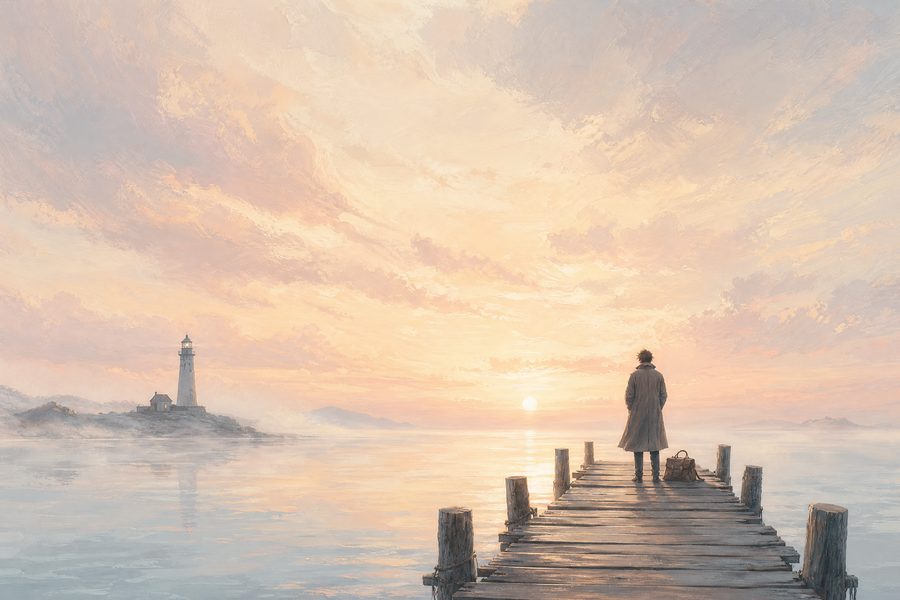
The lighthouse is the first thing you see. Before the title card, before you have any control, the camera holds on it for perhaps six seconds across a stretch of pale water, and then the game begins somewhere behind you and never mentions it again. It does not need to. For the next eleven hours the lighthouse is visible from roughly two thirds of the game's locations, sometimes as a detail on the horizon and sometimes filling a window, and its constant presence does all the work that a quest marker would otherwise do, without ever telling you what it means.
I want to write about the ending, which means writing carefully. What follows describes the shape of the final sequence but not its content, because the specific event matters much less than the decision behind it.
A journey defined by what it is not
Pier Light is a walking game with a small amount of inventory management and a great deal of conversation. There is no combat, no failure state, no timer. You move between six coastal settlements over the course of a fictional autumn, carrying letters and small objects between people who mostly do not know each other, and the game's only real mechanic is your decision about whether to deliver a thing to the person it was addressed to.
That sounds thin. In practice it produces the most sustained sense of consequence I have felt in a narrative game, because the objects accumulate. By hour seven my satchel held four items I had chosen not to deliver, and the game had noticed each one. Characters referred to letters that had not arrived. A shopkeeper stopped extending credit. None of it was announced; there was no notification, no moral meter, no scene in which somebody explained the theme to me.
The design principle appears to be that a game which never tells you what it is measuring will produce a player who measures everything. It worked on me completely.
The four things it gets right, mechanically
- Persistent geography. The lighthouse's visibility from most locations means you always know roughly where you are without a map screen, which lets the game remove the map entirely.
- Objects as memory. Undelivered items stay in your inventory and are referenced by name in dialogue weeks later. Nothing is silently cleaned up.
- Conversations that end. Characters run out of things to say and tell you so. There is no infinite dialogue tree to exhaust, which makes each exchange feel finite and therefore worth attention.
- Weather as structure. The autumn advances on a fixed schedule regardless of what you do, so a delayed delivery is genuinely late rather than merely pending.
Hour nine, and the turn
Somewhere in the ninth hour the game stops adding new locations and begins closing them. A road floods. A ferry stops running. The settlements you can reach reduce from six to four to two, and the effect is not one of a world shrinking so much as a route narrowing — everything funnels toward the pier that gives the game its name, and the lighthouse gets closer in a way you can measure by eye rather than by percentage.
This is the section where I expected the game to falter, because a narrowing structure usually signals a final act in which the writing becomes louder. Pier Light does the opposite. The dialogue gets shorter. Two characters who had been talkative for eight hours become nearly silent, and one of them explains why in a single line that I thought about for the rest of the evening. By the time I reached the pier itself I was walking slowly out of something like reluctance, which is a peculiar and rare thing for a game to produce without a single mechanical threat.
The refusal
Then the game does not let you finish the crossing. I will not describe what interrupts it. What matters is that the interruption is not a twist, not a subversion, and emphatically not the game being clever at your expense. It is the logical consequence of a decision made in the second hour by a character whose reasoning you have had nine hours to understand, and the moment I understood the connection I also understood that the game had been telling me this was coming for the entire runtime.
Some players will find this unbearable. I have read enough discussion to know that a fair number consider it a betrayal of an eleven-hour promise, and I do not think that reading is stupid. If your relationship to a story is that arrival should be earned by persistence, this ending will feel like a door closed in your face after a long walk in the cold.
My own view is that the refusal is the argument. The whole game is about things that do not reach their destinations: letters, people, apologies. An ending in which you complete the crossing would be a game about perseverance, and Pier Light is not interested in perseverance. It is interested in the specific sadness of a thing that was almost delivered, which it has been demonstrating with objects in your satchel since hour two.
Where it does falter
Two problems, both real. The fourth settlement is noticeably thinner than the others — three interior locations, one of which contains nothing, and a character who appears to have been written for a longer version of the game. And the inventory interface is genuinely poor, which matters more than it would elsewhere because your satchel is the emotional record of the entire story. Finding an object requires three clicks through an unsorted grid, and twice I delivered the wrong item purely through misreading a thumbnail.
| Element | Assessment |
|---|---|
| Writing | Restrained, specific, unusually good at implication |
| Structure | Eleven hours with no filler; act three narrows deliberately |
| Interface | The one clear weakness; inventory needs sorting and labels |
| Performance | Locked frame rate on both test machines, no crashes in two runs |
| Replay value | Substantial; a second run with different deliveries reads differently |
The second run
I played it again immediately, delivering everything on time, and the ending is identical. I want to be clear about that, because a lesser game would have made the refusal contingent on your failures and turned the whole thing into a puzzle to be solved. Pier Light is not offering you a way to fix it. The letters arrive, the apologies land, and the crossing is still interrupted, because the interruption was never about you.
What changes on a second run is everything before it. Knowing what is coming turns hours one through eight into a different experience — quieter, more deliberate, and considerably sadder. That is the mark of writing that was constructed rather than assembled, and it is why the score below is the highest we have given this year.
Verdict
An eleven-hour walk toward a destination the game will not let you reach, built with enough precision that the refusal reads as honesty rather than cruelty. A poor inventory screen and one underwritten settlement are the only marks against it.